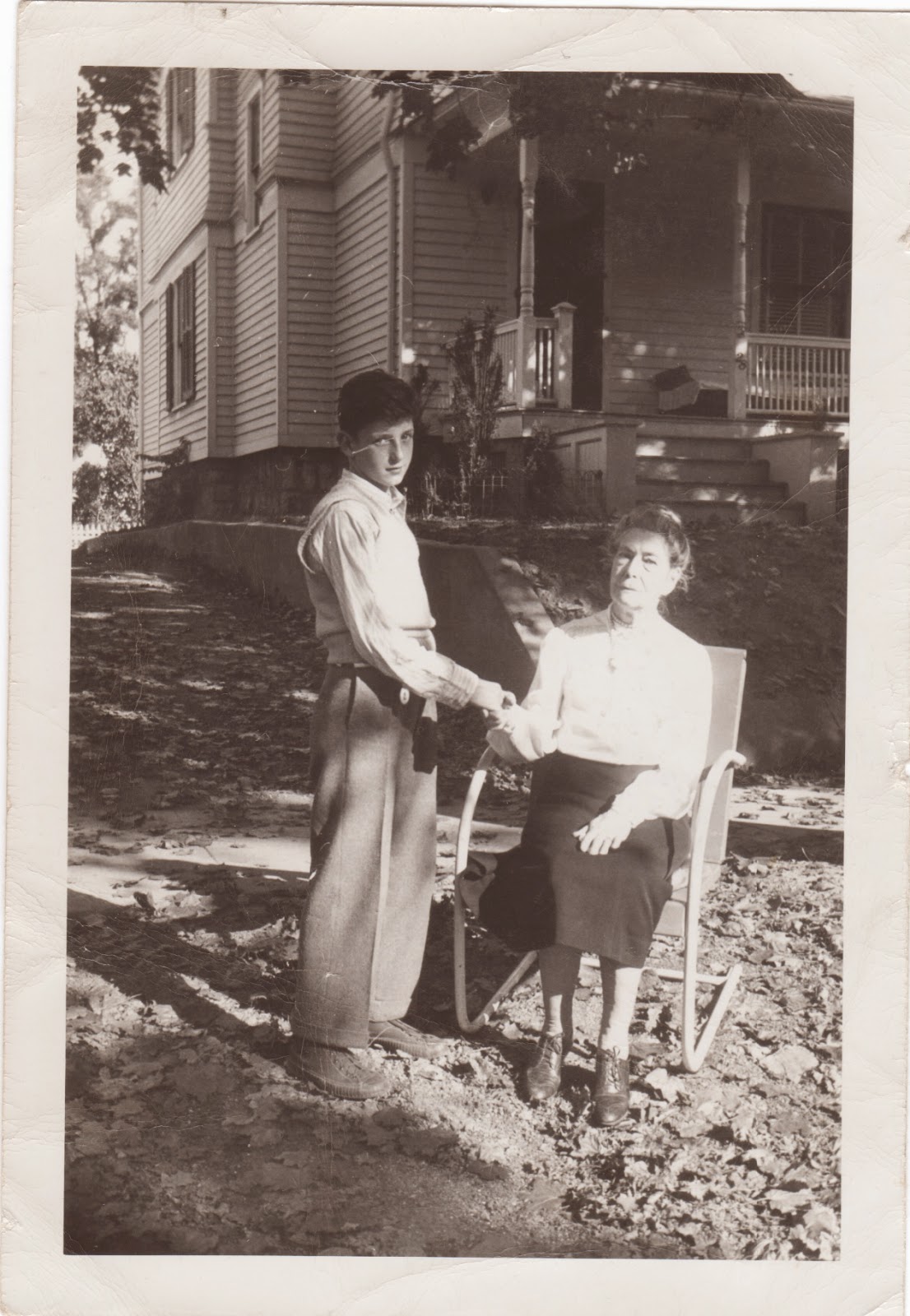
My name is Kathleen, and I have been researching my family history since I was a child. I love to go into county courthouses and smell the old books and paper... or is it dust? This blog will focus on the stories I've heard over the years and the research methods I follow. I am particularly interested in data management and cloud genealogy.

Some of my personal areas of interest include Southern Maryland and DC (Robie, Rhodes, Grimes, Lindsey), NY state (Hill, Cookingham, Flynn, Rhodes, Skinner, Wheeler, Mead, Havens, Trotter), NJ (Parcell), North Carolina and Eastern TN (Lynch, Seabolt, Spears), MO (Wilcox, Kiddell), and CA (Simi, Grady)

I am always happy to compare notes or share my experiences, so please leave a comment!
Showing posts with label family stories. Show all posts

Monday, August 3, 2015

Simultaneous states of being....

About a year ago, I started a series of sketches about my own life for "future genealogy," so in that vein, here's another installment.

I had a great childhood.  My father was a Naval officer and we were constantly on the move. With all that upheaval, my description of a “great” childhood might seem a bit surprising.  The “great” part came from all the unique experiences we had as a family over the years, and I would say that living in Japan topped the list.  From 1968 to 1970, Dad was stationed at the Navy base in Yokosuka, about an hour and a half south of Tokyo.  It is one of those places that seems to hold special memories for anyone who has ever lived there.⁠1  I loved it because I had the freedom to roam around on my bike without parental supervision, and movies at the theater were free.  I think my mom most enjoyed the fact that there were 360 yen to the dollar.

My mother always likes to try new things —“it’s an adventure!” is a phrase we heard often growing up.  So when she saw an ad in the paper seeking westerners for photographic modeling jobs, she thought it would be a fun thing for us to do.  Before long, our headshots were on file at the Eddie Arab Modeling Agency (which, by the way, is still in business today!)⁠2, and we were making regular trips up to Tokyo to meet the agency handler who would take us to the photo shoot.  
www.maps.google.com

Our meeting point was always the dog statue at the Shibuya train station. The statue commemorates Hachiko the dog, who punctually waited for his master’s train every day.  Even after he died, the dog continued his daily ritual of meeting the train for nine more years, until he himself died.  His fidelity has come to symbolize the ultimate expression of loyalty.  Naturally enough, the statue, placed at the spot where Hachiko waited for his master all those years, has become famous as a place to meet.⁠3  
Nancy (left) and Kathleen (right) at Shibuya train station, circa 1969
And I suppose Mom was right… in retrospect, modeling was an adventure!

...I became the face of Suzy Homemaker products,

And some really modern, space-age TV sets:

My sister was on everyone’s breakfast table ….
We were in a few commercials, too… I mostly played board games, while my sister appeared in ads for cameras (below), and Datsun (now known as Nissan).

For some odd reason we did a radio commercial once, saying the Japanese words for “It’s new!” in our American accents.


Mostly, though, we were in ads for clothing:


The 1960s may have been “mod” and “groovy,” but it was also the decade of protests and riots — in 1966, my family experienced some of the drama ourselves, which I wrote about here.  Japan didn’t escape the overall mood of that era, and had its own trouble with violent student protests.  Students weren’t just against the war in Vietnam, they were also concerned about the nuclear weapons coming into Japan on U.S. warships. In 1968, the approaching re-negotiation of the U.S.-Japanese Treaty of Mutual Cooperation and Security⁠4 brought this issue to the forefront.  Whenever a ship carrying nukes docked at the base in Yokosuka, we could be sure of a demonstration outside of the main gate, complete with rocks and tear gas.  (Here’s a link to a photo of the main gate as it looked in the '60s--without the rocks in the air).  

We generally had advance notice of the protests, and were warned to be inside the gates well before they started.  On one of these days, however, my mother, sister, and I were in Tokyo for a photo shoot.   

“No worries,” they told us, when we told them about our deadline. “You will be finished in plenty of time to make your train.”  

Famous last words….  We ran over our time limit, and had to race to catch the only train that might get us back in time.

I remember the trains from Tokyo to Yokosuka were always crowded. 
My mom was pinched countless times, but people were generally nice to little kids.  I was regularly invited onto the laps of strangers (wait, that sounds bad…), and nobody minded when my sister fell asleep on them.
On this day, the trains were crowded as usual, but instead of cute little boys, as in the photo below, the train was full of young men, wearing helmets, carrying shields, and holding signs saying “Yankee Go Home.” It wasn’t quite so cute; we got more than our usual stares on the train that day.  
I remember feeling just a little uneasy on the trip home, but my mother was calm and upbeat as usual.  As our train was arriving in Yokosuka, though, we knew we might not make it to the gate in time.  Even Mom started to get a little nervous; once the gates were closed, there was no entry, under any circumstances.

At the door of the train, we stood ready to spring out and run for it the minute they opened...but we could see the crowds already gathering on the platform as we arrived — a solid mass of angry humanity.  It wasn’t a long walk to the base from the station, but on that day it could have been a walk to Mars.  As the doors opened, Mom took our hands grimly and was about to step into the crowd, when a fellow passenger, all decked out for battle, grabbed her by the arm and said:

“Don’t worry, come with me, and I'll get you to the base!”  

Without another word he pulled us along, and maneuvered through the crowd like a man who knew what he was doing.  Before long we reached the gate, just as it was beginning to close.  Relieved, we flashed our ID cards at the guards, and made it back inside to safety.  From my vantage point inside the gate, I watched our guardian angel melt in to the mob, and transform back into the angry protester, shaking his fist and shouting “Yankee Go Home.”  

Somehow, a person could hate and love  simultaneously.  I’m still trying to figure that one out.

For Further Reading......

     Gibney, Frank, “Politics and Governance in Japan,” in Richard A. Maidment, David S. Goldblatt, Jeremy Mitchell, editors.  Governance in the Asia-Pacific, London:  Routledge Pub., 1998.  E-Library edition pub. By Taylor & Francis, 2005, pp. 70-75 [www.books.google.com, accessed 30 Jul 2015]

Hamaguchi, Takashi.  “Student Radicals, Japan 1968 – 69,″ website describing exhibit of photographs, Dec 4, 2014 – Jan 24, 2015, presented at the Taka Ishii Gallery Photography Paris [www.takaishiigallery.com/en/archives/14892/, accessed 30 Jul 2015]

Marotti, William.  "Japan 1968:  The Performance of Violence and the Theater of Protest," American Historical Review.  February 2009 [http://www.jag.ucla.edu/marotti_ahr.114.1.pdf, accessed 30 Jul 2015]
Oguma, Eiji.  Translated by Nick Kapur with Samuel Malissa and Stephen Poland, “Japan's 1968: A Collective Reaction to Rapid Economic Growth in an Age of Turmoil.”  The Asia-Pacific Journal, Vol. 13, Issue. 11, No. 1 [http://japanfocus.org/-Oguma-Eiji/4300/article.html, accessed 30 Jul 2015].

Discussion Thread: “60s era Yokosuka demonstrations/riots against 'nukes’” 5 March 2009, www.Submarinesailor.com [http://www.submarinesailor.com/bbs2/forums/thread-view.asp?tid=5429&mid=24828, accessed 30 Jul 2015].

Notes

(all photos from the collection of M.G.Hill; used with permission)
1 This is a very unscientific impression gleaned from postings on a closed Facebook Group “Yokosuka Naval Base Past and Present.” [https://www.facebook.com/groups/32380381645/ accessed 30 Jul 2015]
2 Kawaguchi, Judit, "Actor/Talent Agent Eido Sumiyoshi," The Japan Times 14 May 2009 [http://www.japantimes.co.jp/life/2009/05/14/people/actortalent-agent-eido-sumiyoshi/#.Vbz9iHhJetg, accessed 30 Jul 2015]
3https://en.wikipedia.org/wiki/Hachikō, accessed 31 July 2015
4https://en.wikipedia.org/wiki/Treaty_of_Mutual_Cooperation_and_Security_between_the_United_States_and_Japan, accessed 30 Jul 2015

Tuesday, July 22, 2014

Finding Family in Geneva

Exchange Street, Geneva, NY
Geneva is a small city in the Finger Lakes region of central New York, known for its beautiful scenery and popular wineries.  It is also my grandfather's hometown, which he left in the 1930s to find work elsewhere.  Life being what it so often is, my father grew up in a different part of the state and didn't get to know his father's relatives.  

In this Facebook age, we forget how easy it was to drift apart and lose touch, but that's what happened in my Dad's family.... that is, until I met Carol through DNA testing (you can read about that story here)... and the rest, as they say, is history.  

I just returned from our first family gathering, reuniting descendants of the five sons of John J. and Julia Mary (Flynn) Hill. I've written about this family before (see "Trust but Verify" and "Crossing the Pond"), and this trip was my chance (and my Dad's) to finally meet this branch of our family.  I loved seeing all those intense blue eyes -- it was a tangible reminder of our shared DNA.  [Overheard at the reunion:  The Hills have eyes...]

Most importantly, I heard some stories that shed a little bit of light on the personality of Grandma Julia.  My father's cousin Jack grew up in Geneva and lived with his grandmother, so he could tell us a few things about her.  
Jack with Grandma Julia, mid-1940s
Julia was a hard-working woman.  After her husband died in 1916, she kept a boarding house, and would get up every day at 4 am to start the day's baking.  She was no-nonsense with the children, but must have had a kind heart, because she was always ready to feed hungry strangers at the back door.  

Jack told about how her five adult sons would sit in the living room drinking their whiskey; when offered a shot, Julia would grimace and protest, refusing to take more than a sip.  When the men left the room and she thought no one was watching, she would drink it straight down, pretty as you please.  

Whenever anyone was sick, she would insist they take the "cure" -- whiskey, water, and a spoon of sugar.  It got so that sometimes the kids would go into the kitchen and cough hopefully at her.  

On St. Patrick's Day, she would bake a cake, and when it came out of the oven, she would spread out newspapers and throw the cake against the door.  It would break into pieces and everyone had to eat a piece of the broken cake for good luck.

Jack told about the divisions between the Irish and the Italian kids.  The Italians had to go through the Irish neighborhood to get to school.  Jack, a slight boy, used to sit outside as bait, taunting the Italian kids.  When they started to come at him, his bigger cousins would jump out from the bushes.  If the noise got too loud, their grandmother would come out of the house with a broom to shoo everyone back to their side of the tracks.

Now here's when you know that there is the hand of fate in family history: my new cousin Carol arrived a few days before the reunion and went to visit St. Patrick's cemetery, where our great-grandparents are buried -- only to find that she had no clue where to look for them in the enormous expanse of gravestones.  Ready to give up, she ran into a gentleman walking nearby, who asked her who she was looking for.  She told him.... and Jack led her straight to the family plot.  Of course the random person she happened to meet would be the only person in Geneva who could help her!  

image courtesy of  thegraphicsfairy.com


Monday, June 23, 2014

A lesson in walking between the worlds

This morning I woke to the news that Fouad Ajami had passed away.  He was a brilliant commentator on the Arab world, featured often on CNN and in the Wall Street Journal. I knew him many years ago when I was a student at the Johns Hopkins School of Advanced International Studies and he was my academic advisor.

Fouad came to the US as a teenager, and one of his strengths was his ability to walk between worlds; he was a product of two cultures, and was able to interpret the Arab world for a West that, at best, was puzzled by it, and at worst condemned that world without understanding it.

His genius lay in his ability to go beyond the obvious and immediate reasons events unfold as they do in the Middle East.  It wasn't merely that he drew from a deep understanding of history; rather, he could pinpoint and evoke the cultural myths and stories that motivate actors in the Arab world.  Because he spoke in words of myth and archetype, he could speak to everyone -- and this helped us understand a world that was culturally beyond our ken.  Fouad was a poet in his soul, and I was privileged to have been his student.

But why note this on a family history blog?  Fouad knew that stories motivate.  If you know a culture's stories and myths, you can understand them on a deeper level and begin to sense why things happen as they do. The same is true for individuals and families.  We need to understand our ancestor's world view, their beliefs about themselves and their place in the world.  The best way to do this is to read voraciously:  national and local histories, of course, but what about the physical world of our ancestors -- were there droughts, storms, or other natural disasters that may have impacted their lives? How did they get around -- what kind of roads were there, or did they rely on transportation by water?  What kind of things did our ancestors find entertaining -- who were the pop stars of their time?

Learning about the external circumstances of our ancestors' lives, combined with a broad understanding of historical trends, allows us to take baby steps in walking between the worlds... and bridging the gap between our own lives and the "foreign country" that is our ancestral past.

Saturday, June 14, 2014

Future Genealogy... and life on Hunter's Point, 1965-1968

Although I spend so much time gathering the documentary evidence of my ancestors, I tend to give relatively little thought to my distant descendants.  It's time to change that approach; we are all links in a chain, and the links that come after us are just as important as those that came before.  More and more I'm hearing prominent genealogists (Tom Jones and Judy Russell immediately come to mind) advocate gathering your own family's story while you still can.  At Rootstech this year, Judy Russell reminded us that oral history is lost within three generations.  

The records of your life are relatively easy to find -- and will become even easier in the future with digitization and crowd-sourced indexing -- but the details of who you are as a person can be lost very quickly.  I want my descendants to know about the choices I've made and how the experiences in my life have shaped my world view.

Aside from a personal time capsule (which, by the way, my family and I have actually created and buried in the foundation of our home!), the next best gift to the future would be an autobiography. For mine, I've decided to start with the time our family lived in Hunter's Point, San Francisco.  

My Dad was a career Naval officer, with advanced degrees in naval architecture/marine engineering and, later, in business administration.  In 1965, we were living in Boston, when he received orders to report to Hunter's Point Naval Shipyard in California.  

The Navy never did things the easy way -- most of our moves involved crossing a continent or an ocean.  (I told a story about this particular trip when I first started blogging, in "Tales of an Old Cattle Wrangler.")  We arrived in San Francisco in June -- my mother was thrilled to be in California!
I think San Francisco was one of my mother's favorite places to live

The shipyard was fairly close to the city...and there was the usual close Navy community, so inside the base, we fit right in.
source: Google Maps, personal knowledge

Our quarters were on Innes Avenue, just a block from the main gate:
1962 Map of Hunter's Point Naval Shipyard (source: SFgenealogy.com; annotations are my own)

As you can see, the Hunter's Point shipyard was surrounded on three sides by water.  The fourth side was comprised of the Hunter's Point and Bayview neighborhoods, which were relatively isolated parts of San Francisco with limited access to public transportation.  The population in this area was predominantly low-income African-American families; poverty and crime were rampant.  

The mid-sixties were difficult years for America, as we struggled with creating a just society for all.  While the lack of civil rights was perhaps more obvious in parts of the country where Jim Crow laws physically separated the races, places like San Francisco were equally discriminating:  to put it simply, African-Americans had far fewer opportunities for housing, employment, and education.  It was more insidious in San Francisco by the very fact that the effects of racism were hidden in pockets of poverty that most people never saw.  (Kelly & VerPlanck, p. 10)

Living in this new world, what struck me was the smell.  I had no frame of reference for this, so I complained to my mother that it smelled like the circus.  It was, in fact, the remnants of San Francisco's once-thriving slaughterhouses, which remained in this part of the city through the 1960s.  (Kelley & VerPlanck, p. 7)


A picture of a friend taken in our front yard -- you can see all the heavy industry right next door!
Living on base was like living in any small town -- we had a movie theater, community center, churches and a library.  We did not have schools on the base, however, and so the Navy provided bus transportation to various schools in San Francisco.  My bus driver was named Merle, and I just loved him; he knew all the kids by name and would laugh and joke with everyone.  My favorite place to sit was right behind him so we could talk.  Everyone knew that this was my spot. 
I'm on the far left, with other "Navy Juniors" and Merle

One day, though, I got on the bus and was horrified to see that Merle was not driving and my seat was taken.  

By an MP with a rifle, no less.  

I remember standing there with my arms akimbo, glaring at the soldier, as if the force of my indignation would make him move.  He didn't smile, or even look at me, and eventually I got the picture and found another seat.

Over the next few days and weeks, we kids knew that there was a lot going on outside the base.  For one thing, there were more crowds out on the streets surrounding us, and rocks and bottles were thrown over the fence from the outside.  One family, whose quarters directly adjoined the fence, had to move because of the smoke bombs and molotov cocktails that were thrown into their yard.

...And the armed MP continued to ride our school bus for several weeks afterwards.

I never knew the details of the disturbances until just recently, when I started to do the research for this blogpost.  I learned that on September 27, 1966, a white policeman shot a black teenager who supposedly refused to stop for questioning after a car was stolen.  This was the final straw for a community already smoldering with resentment against whites who marginalized them and essentially blamed them for their own poverty.  Riots broke out and the governor called in the National Guard.  Even back then, I knew that there was some reason that black people and white people didn't get along, but for the life of me, I couldn't figure out what it could be.  

You see, Sheila, my best friend from school, was black.  And yes, we had fights, but we always made up later.  I don't remember exactly where Sheila lived, but it was in the general vicinity of the base -- sadly, I could visit her, but she was never able to visit me.  I remember one such visit; we went around telling everyone in her neighborhood that we were cousins.  I'll never forget how I felt when a boy said, "no, you can't be cousins -- she's caucasian!" ... and the way he said it, he might have been saying: she's the devil.
My second grade class at St. Paulus -- here I am with Sheila
Now I want you to understand that I'm just reporting my memories -- clearly not reality as it existed for the Hunter's Point and Bayview communities.  For that, I refer you to any number of websites and articles about the riots in 1966.  But this was my first exposure to the concept of "difference." 

This...
Photo credit: "The 1966 Hunters Point Rebellion," The San Francisco Bay View; National Black Newspaper, 2 Sep 2011
...was literally just a few blocks away from this:
photos taken at 560 Innes Avenue, Hunter's Point
I was very much aware of the disparity between our lives and those of the people in the surrounding communities.  It was hard not to be, driving through them every day going to school.  As a little child, though, all you could do was to hold it in your heart -- to be reconciled and healed someday.

For us, life calmed down quickly after the riots subsided.  Things got back to normal, Merle returned to driving my bus, and I got my seat back.  In June of 1968, after a few months of real fear that my father would be sent to Vietnam, he was transferred instead to Japan, and we were able to move there with him.

My takeaway from this experience was that despite all our external differences, people are all the same at heart.  The truth is, life isn't fair -- and it never will be.  There will always be rich and poor, but that distinction should be a result of a person's own ability, initiative, drive, or lack thereof, but it should never, ever be based on the color of a person's skin.  

And let me tell you, there is still quite a lot of work to do before that will be the common perspective in our world.

Further Reading on Hunter's Point and the 1966 Riots

Kelly & VerPlanck Consulting, "Bayview-Hunters Point Area B Survey; San Francisco, California Historic Context Statement," Prepared for the San Francisco Redevelopment Agency, 11 Feb 2010 
(http://www.sanfranciscohistory.com/BVHP_Context.pdf)  (This is a fascinating look at the historical development of this San Francisco community from the 18th century to the present, including a detailed examination of the trends leading to its isolation and blight in the post WWII years.)

Chris Carlsson, "The Hunters Point Riot; Unfinished History." on FoundSF [online digital archives] (http://foundsf.org/index.php?title=The_Hunters_Point_Riot)

"1966 Hunters Point Uprising and other tales of 'San Francisco's Last Black Neighborhood,'" The San Francisco Bay View; National Black Newspaper, 24 Sep 2009

(http://sfbayview.com/2009/1966-hunters-point-uprising-and-other-tales-of-san-franciscos-last-black-neighborhood/)

"Property Damage After Bayview Hunters Point Uprising," September 1966 [video] San Francisco Bay Area Television Archive, (https://diva.sfsu.edu/collections/sfbatv/bundles/217094

"Hunters Point Shipyard Closure Protests," 26 April 1973 [video] San Francisco Bay Area Television Archive, https://diva.sfsu.edu/collections/sfbatv/bundles/217408.  (This video shows protests at the gate, which was just a block from our house.  We were long gone by 1973, but it looked just the same when we lived there.)


Monday, September 23, 2013

Some thoughts on having a genealogy elevator pitch

I just returned from the inaugural New York State Family History Conference in Syracuse.  While there have been New York tracks at other conferences, at last there is an event focusing solely on research in New York State.  Sponsors expect this to be a biennial event, and I certainly plan on attending the next one in 2015!

New York has a reputation of being difficult to research due to a complex legal system, inconsistent record keeping, changing jurisdictions, and countless records lost because of fires and natural disasters. Speakers at the conference helped navigate this morass, and I left feeling that I might actually have a new plan of attack for my most challenging brick walls.

One of the best parts of going to a genealogy conference, though, is that you are surrounded by 400 others who share your seldom-appreciated obsession with dead people.  The trouble is, most of them are interested in other dead people and have not the slightest shred of interest in yours....and that's what I want to talk about.  

There is an art and a science to getting along with others at a genealogy conference!  I can't tell you the number of people I met who wanted to tell me a long and convoluted story about how they finally found their ancestral family out of ten others with the same name.  Others want to detail every step they took tracing their ancestor's home in the old country.  My perennial favorite is the type that insists on telling me that they have researched their family back to 1425 -- then proceeding to tell me all the names in their tree.   People like this must get so much indifference from their friends and family that they are desperate to share their discoveries with anyone who will listen.  

I am fortunate enough to have a wonderful husband who listens and encourages, and even occasionally asks questions, so I don't feel the need to tell my story to strangers.  (Well, I don't count this blog....you, dear reader, are free to click away at will and I won't be offended!)  

The fact is, each and every one of the people who bore us at conferences have wonderful stories to share if they could learn to package them differently.  In business, there is something called the elevator pitch.  Successful salesmen should be able to summarize their service or product in the space of a 30-second elevator ride.  

As genealogists, we should all come up with an elevator pitch describing our research interests.  Remember that no one cares as much about the details of your research as you do, so try to focus on general themes instead:  "I am researching a Wheeler family in Schoharie County that came from Connecticut around 1820".... or "my Cookingham family descended from the Palatines who settled in East Camp in the early 1700s."  We all have a lot of ancestors, just choose one to start a conversation!

Sometimes if you leave out the names, and omit the steps you took to discover the information, you are left with the bare bones of a tale that others can actually relate to.  Remember that stories have universal appeal.

I was preparing to assume the glazed look of polite boredom when a woman I met at the conference started to tell me about her research.  She told of reading the Civil War pension file of a man who stood up when his commander said get down: he was shot by the enemy and was left for dead on the battlefield.  Somehow he survived, but was seriously injured and lost his memory.  All he had to guide him was a Bible inscribed with a surname, the first initial "H," and a regiment designation.  He eventually married and had children, but for most of his life didn't know his own name, variously going by Harvey, Harold, Henry, etc.  He finally found out who he was in 1915, when he read in the paper that there was to be a reunion of the regiment listed in the Bible.  The old boys nearly had a heart attack when he showed up, all exclaiming:  "But you were killed!"  

I have no clue whose family this story belongs to, or how many hours the woman spent reading through pension applications before she came to this one.... none of that matters to anyone but her. But boy, I'm glad she shared that story!

Monday, May 27, 2013

Honoring those who served

Happy Memorial Day to everyone in the United States!  

I'd like to thank everyone who has served our country in any capacity, but especially those in the armed services.  It takes a special person to stand in harms way to defend our country and our values, and I am grateful for their service.

I am especially proud of my Dad, Martin Hill, who is a graduate of the US Naval Academy, and served his country for 30 years as an officer in the United States Navy.

I am also very proud of my father-in-law, Henry Tesluk, who served in World War II as an army doctor attached to the 1777th Construction Engineers in France, the Philippines, and in occupied Japan after the war.

To help tell the story of Henry's war-time experiences, I've created an interactive Google map, which is built around the travelogue that his unit produced.  Each icon on the map links to a place on their journey and contains Henry's personal photos, notes from the travelogue, as well as vintage WWII films from youtube.  I put this together so his grandchildren could understand what he went through during the war in a more personal way.

View Henry Tesluk's WWII adventures in a larger map

It's always a good idea to examine your data through different lenses, and Google maps are a good tool to help you see your ancestors geographically.   Another great resource is Treelines, which provides an elegant way of presenting the stories that may be revealed within our research.

Monday, March 18, 2013

Family history is important to your psychological health

I really should be packing for Rootstech, but I was reading the Sunday New York Times this morning and came across "The Stories That Bind Us" by Bruce Feiler.  It turns out that people who know a lot about their families do better when they face challenges in life -- anything from a skinned knee to a terrorist attack. They are able to see difficulties as part of the normal cycle of ups and downs all families experience.  I thought about this in terms of my own extended family.  Over the years we have formed a strong family narrative:  there are the success stories, the sad stories, the happy stories, and the ones you just don't want to think about, but it is all a part of who we are.   (I still say "sorry about that, cheese" even though my baby cousin who uttered that while watching "Get Smart" now has grown children of his own).  We are definitely not the kind of family that refuses to talk in front of the children!

I've written before about my grandfather, a charismatic larger-than-life figure who was full of tall tales, and no one in our family can forget how my grandmother and her twin sister came into the world.  I haven't yet told you about how my grandmother's parents met:
Abel Perminter Lynch and Jessie Lee Seabolt Lynch, ca. 1896
In the early 1890s, my great-grandfather Abel was a traveling sewing machine salesman.  He was from North Carolina, and his territory extended west into eastern Tennessee.  One day he was at the western end of his route, and stopped at a farm to give a demonstration (all the little girls in the area would come to watch because he would sew doll's dresses,which they could keep), and complimented the farmer on the beauty of his wife, saying that if there was another like her, he might just settle down and marry. The farmer said, well, you're in luck, sir!  If you just go down the road a bit, there are seven others just like her still at home and you can take your pick!  So he did, and fell head over heels in love with his Jessie Lee from Tennessee. He had to take out a bond to marry her, though, since her folks didn't quite trust those traveling salesman types.

The family narrative goes back even further in Jessie's family: we are still talking about what happened to them during the civil war!  After their home had been ransacked multiple times by transiting Yankee soldiers, all the family had left was the honey in their beehives.  When yet another group of soldiers came through, the only vessels they could find to take away the honey were the "honeypots" -- and my family has been laughing at them ever since.  I would add that a family that has a sense of humor can probably withstand any challenges the world can throw at them.

I look back at the families I really know about in my own tree, and it is pretty clear that the impetus to tell stories and keep the traditions alive (and talk, and talk, and talk) all come from my mother's maternal family.  One thing I can say is that every male who married into this line has thanked their lucky stars ever since!  Folks on my dad's side were not great communicators -- so it's a good thing I can use online newspapers to fill in their stories (and some of them are really good, too.... but that's for another post!) Others in my family lines might have been good storytellers, but were cut short when parents died young.   In the end, though, uncovering these lost stories is what really drives us all in our genealogy research.

Monday, March 11, 2013

A postcard from your ancestors

I am very excited about a website I've been exploring this week:  Old Fulton Postcards.  It is an amazing source of digitized newspapers throughout the state of New York.  I've known about it for a long time, but never really explored beyond the home page because the title made me think it focused on the town of Fulton.  My ancestors came from another part of the state entirely, so I didn't go further -- shame on me!

Small town newspapers are especially great sources for reporting on the comings and goings of people.  I learned that one of my 2nd-great grandmothers seemed to be a local Florence Nightingale, helping out whenever people were sick.  I learned the married name of her sister, too, when the paper reported that she was visiting from Albany.  This kind of social reporting can be an absolute gold mine for providing the small details that can help knock down brick walls.  A little gem like this:


.....helped me realize that there was still a connection between distant families two generations beyond the only other one I knew about (an indirect mention of a sister-in-law in a census entry more than 30 years earlier).  I still need to work out details (first names would be a nice start) to help me identify the proper New Jersey family, but this tells me they exist.

Sometimes you can get a glimpse of an ancestor's personality.  My great grandfather comes across as a very energetic guy.  He was a horse dealer and was constantly in the paper, either advertising his horses, running them in a race, or coming up with new ideas for making sales -- too bad he didn't live in the internet era or he might have been the one to invent ebay!


And then there are those things you read about that make you cringe, and give thanks that we live in a less dangerous age:


So if you have any ancestors who are from New York.... or even visited New York.... check out this wonderful resource!


Friday, August 24, 2012

DNA: a recovered past

I've been away for nearly a month on a wonderful adventure with my family, and I have lots more to write about my Genealogical Research System (and photos will be posted on my art blog)..... but all that will have to wait until I get over jet lag and clear the backlog of stuff  that always accumulates after a trip.

I do want to share an amazing thing that just happened, though.  Just before I left, my father agreed to submit a DNA sample to see what we could learn about the deep history of our paternal line.  When I returned, there was an email saying the results were in, and oh, by the way, you have an exact match.  I was pretty excited, especially since this line is a fairly common surname and represents my "brick wall."

So (jet lagged or not) I contacted the match, asking if we might be related, and she responded almost immediately with a resounding YES!!! As it turns out, Carol is my second cousin once removed, and while we didn't resolve our brick wall, now there are two of us working on it, and it doesn't seem like such a lonely job anymore.

But the real wonder and miracle of this is Carol's story.  You see, she never knew her blood-surname.  There was a family dispute in her grandparents' generation in which one parent betrayed another, and the betrayed one vowed never to have anything more to do with the other.  She took the children, forbade the father from ever having contact with them, and changed their surname.  How she managed that in the small town they lived in is a mystery to me, but Carol's father grew up not knowing his family, although they surrounded him silently, unable to reach out.  Years later, when he learned the truth, he discovered that one of his aunts had even been his school bus driver.

Carol and I spent a long time on the phone, sharing our family stories.  I was startled, but not surprised, to hear that deep blue eyes are a strong feature in her family, because that's something that stands out in my family, too.  As we talked, it was clear that for Carol, making this connection was more than just finding another name on the family tree -- this was about personal identity and belonging.

One reason I am so passionate about genealogy is because family itself is so important.  Knowing our family -- for better or worse -- places us in a context.  The "I am" statement cannot exist in a vacuum.  Things we think of as ours alone (that singing talent, the academic propensity, even our blue eyes...) more often that not are rooted in our genes.  We pursue those deep genetic ties because we realize that at some point, we are all related, we are all one family.

Post Script:

I sent this post to Carol to read before I published it, and she replied with a poem she had written a few years ago:


Daddy said he loved me as he held my hand.
He told me to always remember my family and never forget who I am.
I said, I will never forget Daddy.
He smiled at me and we walked.
Mommy said she loved me as she moved a stray hair from my head.
She told me to be brave and always look for goodness and never forget to forgive.
I said, I will never forget Mommy.
She smiled at me and we walked.
They died that day, on that walk.
But I never forgot.
I never forgot.
I looked up at the sky and smiled as I walked.

Carol Ehrenreich

Thursday, October 6, 2011

There will be a change of help in the Tilden household....

I came across an interesting article in the San Francisco Call the other day while searching for my husband's great-grandfather.  Theodore Grady generated quite a lot of mentions in the newspapers during his lifetime because of his unusual status as a well-educated man with special needs.  He was the first deaf-mute in the state of California to graduate from a college for the hearing (UC Berkeley), and the first deaf man to pass the California bar and work as an attorney.

This particular article really struck home because it highlights how far our society has come in dealing with people with special needs.  Theodore Grady was only a side note in the story, which centered on his friend, the sculptor Douglas Tilden.  Tilden came home late one evening, realized he had forgotten his key and let himself in by a window.  A servant thought he had gone mad and called the police, who hauled him off.  Justly incensed, Tilden was agitated, but because he was mute he couldn't explain himself.   He was given a "quieting potion," and slept it off until his family came to get him the next day.  The story ends with the dry comment: "There will be a change of help in the Tilden household."

 You've just got to read it for yourself in all its glorious wordiness (here's the link if you want to see the original page):

Tuesday, August 2, 2011

Twins are amazing!

How fun is the internet!  Most of the time you go online with a specific task, get the information you need, and you're out of there.  But then there are those days where you are sucked into the black hole, and you come out hours -- or even days -- later with no memory of what you were doing, or where the time went.  Well, it's been my experience that if you don't over think things and just go with the flow, sometimes you get some really good stuff.

Like today.... I was reading emails and somehow got sidetracked to the genealogy posts on the Family Tree Magazine forum page.  This post sparked my curiosity, and with a little more sleuthing, I found the following image on the Library of Congress website:


(click here to see the full image)
The caption read:

Twins become mothers together for second time in less than two years. Washington, D.C., April 7. Accustomed to doing practically the same things all their lives, these Washington twins, now mothers, have apparently decided that having their children together would certainly be in order. The mothers, Mrs. Eileen Moon, left, and Mrs. Kathleen Robie, last week gave birth to daughters to set a new record at Columbia Maternity Hospital. Mrs. Moon's youngster, whom she named Carol, was born on March 29, while Mrs. Robie's new daughter Nancy Lee first saw the light of day on April 1. This same thing happened in July 1937 when Mrs. Robie gave birth to a girl and a few hours later Mrs. Moon's baby, a boy, arrived

  • Digital ID: (digital file from original negative) hec 26626 http://hdl.loc.gov/loc.pnp/hec.26626
  • Reproduction Number: LC-DIG-hec-26626 (digital file from original negative)
  • Repository: Library of Congress Prints and Photographs Division Washington, D.C. 20540 USA http://hdl.loc.gov/loc.pnp/pp.print


My mom is the baby on the right.  I have to say, genealogy is doing well in the digital age!

Tuesday, July 5, 2011

Three things....

The theme for this week's Texture Tuesday over at Kim Klassen's Cafe is "Three."  I tried to play with this idea, but everything I came up with seemed so trite and clichéd.  That's not to say that my solution isn't any of that, but it suited me -- and that's all that matters.....

I thought of three heirlooms that have come down to me from my great-grandfather, Abel Perminter Lynch, who was born in Rutherford County, North Carolina on 13 January 1859. They are: a prayer book, a pen, and a wonderful tin box, which, according to family lore, once held cash that his father buried for safekeeping during the civil war.
Click here to see all the wonderful images over at Kim Klassen's Texture Tuesday party!

For those who are interested, I used three of Kim's beautiful textures on this image: "canvas back" (color burn @54%), "warm grunge" (overlay @ 60%), and "pourvous" (overlay @100%).  I happen to like the warm color and distressed, vintage look you get with a heavy hand on the textures, although some might think it is overdone.  I'm curious -- am I alone in this?

Back to Abel.... Here he is with his twin daughters, Eileen and Kathleen.  My grandmother was Kathleen, and I don't know which one she is in this picture since they were identical twins.
I love this picture of Abel with his girls:  he looks so glum, yet resigned to his fate.  You see, he was 60 and his wife, Jessie Lee (Seabolt) was 45 when the twins were born.  Jessie and Abel were just about to retire to the good life down in Florida, when doctors doing gall bladder surgery discovered that she was pregnant.  In 1919, that was practically a death sentence, so they sewed her up and sent her home.  They moved back in with Jessie's family in Tennessee, where she made a gown for the baby's burial and prepared for the end.  Much to their surprise, "the baby" turned out to be healthy twins; everyone survived, and Jessie and Abel had to scramble to find clothes and cancel their retirement plans so they could raise those babies!

For years, my great-aunt Eileen wanted to be on the "What's My Line" TV show.  Her line was that she was the middle child:  her brother was 25 years older than she was, and her sister was 25 minutes younger....

I made this wall hanging for my grandmother a year or so before she died.  She and her twin sister (or "sin twister") were very close, as you might expect, and in typical twin fashion, dressed alike, had their children days apart, often even bought the same furniture without knowing that the other had done the same.  Both were very active in international causes (in fact, a faculty office at the Johns Hopkins University's Bologna Center is named for them) and they both loved family history.  My grandmother was my genealogy buddy and inspiration, and I miss her.

Thursday, June 2, 2011

Tales of an old cattle wrangler...

William Francis Robie was certainly a storyteller.  I remember one time when I was just a very little girl, and we were walking around his family farm in Charles County, Maryland.  He pointed toward an old tree stump we could see in the distance up on a knoll.  "That," he said solemnly, "was where I was born."  We walked a bit further.  "Yep," he continued, "it was a dark and stormy night, and the wind was howling something fierce.  Then, all of a sudden there was a giant clap of thunder, and a huge bolt of lightening struck that old oak -- snapped it off at the roots -- and next thing you know, I stepped out of the stump, fully grown and wiping the the rain off my matching six-shooters."

All that a young girl could do in the face of such magnificence was to nod her head, awestruck.

Pop had a way of making you feel happy and excited, and sure that some adventure was imminent.  When I was five, my family moved from Boston to California.  Pop came along on the trip to help my parents with the driving, but I think it was secretly because he wanted to go through Texas -- he was an archetypal Texan in a Marylander's body.  Anyway, once we reached California, we stopped at Knott's Berry Farm for a little bit of fun towards the end of our long drive across country.

Now, Knott's Berry Farm in the mid-1960s was a much more low-key place than it is today -- back then, it was more about panning for gold, or "talking" to plaster images of old prospectors than it was about thrill rides.  My sister and I were waiting in a line to talk to one of these plaster old-timers languishing in a jail house, and could overhear all the conversations taking place with the kids in line before us.  The old guy would say something like, "well, howdy, little girl!" or "hello there, young feller!"  Then, it was our turn, and he exclaimed:  "WELL, IF IT ISN'T KATHY AND NANCY!"  We could only gape at him, dumbstruck.  "Your grandfather and I were cattle wranglers together, back in Texas!  You know, to this day I don't know how he managed to get out of that jail back in Amarillo.  Well, that old fox could outsmart them all...."  He went on in that vein for quite some time, and we were spellbound.  You see, we had heard these stories our entire lives, and the thought that this old timer knew them too (even if he was made of plaster) was just amazing.  I think I can truly say it was one of those magical moments in life, when you are just filled with wonder.

Here I am with Pop, at one of those ubiquitous gas stations with a pony ride, somewhere in the middle of the country.

Pop, as one of those plaster old-timers at Calico
branching out--boots


My grandfather was an expert at making all his children and grandchildren feel that they were the most precious thing in the world to him.  At Thanksgiving, Pop would always take me aside, fingers on his lips:  "Shhh, don't tell anyone..... I've saved the best part of the turkey for you," and pop some morsel into my mouth.  Of course, he did the same thing for everyone else, but somehow managed to make each one of us feel special.  We love you, Pop!