My name is Kathleen, and I have been researching my family history since I was a child. I love to go into county courthouses and smell the old books and paper... or is it dust? This blog will focus on the stories I've heard over the years and the research methods I follow. I am particularly interested in data management and cloud genealogy.

Some of my personal areas of interest include Southern Maryland and DC (Robie, Rhodes, Grimes, Lindsey), NY state (Hill, Cookingham, Flynn, Rhodes, Skinner, Wheeler, Mead, Havens, Trotter), NJ (Parcell), North Carolina and Eastern TN (Lynch, Seabolt, Spears), MO (Wilcox, Kiddell), and CA (Simi, Grady)

I am always happy to compare notes or share my experiences, so please leave a comment!
Showing posts with label Hill. Show all posts

Monday, March 21, 2016

DNA breaks through a brick wall... and shakes things up!

 I have recently learned that my great-grandfather, John Joseph Hill, was not, in fact, deposited in Geneva, New York by aliens.

With a name like "John Hill," I knew I'd never find where he came from before he turned up in Geneva, listed as "laborer" in the city directory for 1894.1  There are any number of men with this name who came to America in the 1890s.  Without any identifying information distinguishing one from another, I had little hope that I would find my ancestor among all the anonymous, random Hills out there.  All I knew about his past came from his 1896 marriage record and his death certificate from 1916, both of which named his parents as "Thomas Hill and Elizabeth Scott."  In later years, his children variously identified their father's country of origin as either England or Ireland, and there were vague stories floating around that he or his father had been a "Bobby2" back in England, but that was literally all I had to go on.

All this changed a few months ago, shortly after Ancestry opened sales of their DNA kits to the UK.  I noticed that my father and my uncle had a new match at the 2nd-3rd cousin level, and I was intrigued by the fact that this match was from a person living in England.  Almost certainly, then, this was a match on my father's paternal side, since his mother's family has been in the U.S. since the earliest settlements.  So I looked at our match's tree, and saw the proverbial shaky leaf pointing straight back to.... Thomas Hill and Elizabeth Scott.

And what a story this has turned out to be!  Our Hill family was from Cork, Ireland, where Thomas Hill and Elizabeth Scott had a family of ten children:  eight girls and two boys.  One of these boys was my great-grandfather, John, and the other was named Robert Albert (John gave that name to one of his sons in America.)  Several of the girls emigrated to Australia and New Zealand.

Our DNA match knew about my great-grandfather's existence, but it was otherwise a blank spot on his family tree.  My cousin's family had preserved letters written by John's sisters in the early 1900s, and one in particular struck me as poignant.  It was written just after their mother's death in 1901, and lamented the fact that John had gone off to America and never looked back, causing her a great deal of sorrow in her final days.

Some of the information our new cousin shared will shake this American family's identity to the very core... and since they are from Ireland, naturally it has to do with religion.  My grandfather, George, and his four brothers, Earl, Warren, Robert, and Vincent, were raised as staunch Catholics by their mother, Julia Mary Flynn, who in 1896 married John Hill at St. Francis de Sales RC Church in Geneva.3  We always assumed that John was Catholic, too.  Not so!
John Joseph Hill, Julia Mary Flynn Hill, and son Vincent, in Geneva, NY, sometime before John's death in 1916
In fact, John's family belonged to the Church of Ireland.  Not only were they Protestant, but his father, Thomas, was a Sergeant in the Royal Irish Constabulary, the armed police force that was notorious as a symbol of British oppression. 


Well, at least we know that those vague rumors we have heard about the Hill family being in the police force were true.  As it turns out, quite a number of other family members were involved in police work, too:  spouses of some of the sisters, as well as an uncle.  And there are more mysteries....an undated news clipping of Elizabeth Scott's 1901 obituary (another bit of information sent by my new cousin), suggests that my great-grandfather John might also have joined the force before emigrating:  


"A Record:  -- On Friday, 18th inst., at her residence in Cork, and surrounded by her daughters, there passed away at the great age of 81 years, Mrs. Hill, widow of the late Sergeant Thomas Hill, R I C.  Sergeant Hill, in his young days, served in Scull under his father (who was one of the first R I C men).  He afterwards had charge of the station midway between Cork and Mallow, in the year of the famine, and on retiring in Donaghmore, some 37 years ago, obtained a lucrative position in the Steam Packet Company's office in Cork, which, at his demise in 18__ was filled by his son, who afterwards joined the R I C, so that the family was associated with the Force in one direct line from its origin to the present day, which is indeed a record."4

This last statement in the obituary is a little confusing, since Elizabeth probably only had two sons, neither of whom was working in Cork in 1901:  John was in the U.S. by at least 1894, and a cryptic comment in one of the letters my cousin shared suggests Robert was most likely dead that same year. Add to this the mangled, chronologically impossible story in our family that Grandpa John fought in the Boer War before coming to America  -- but you know those family stories!  

Genealogists are used to conflicting data, though...it gives us something to work on. Next time, I will summarize the research I've done corroborating the information in the letters shared by my new cousin.

_____________________________________________________________________________________________
1Geneva Village Directory For the Year Beginning May 1, 1894, p. 86 (Geneva, NY:  W.F. Humphrey, Publisher, 1894); original volume consulted at the Geneva Historical Society, 543 S. Main St., Geneva, NY. 

2The term "Bobby" is slang for a policeman, from the British police force raised by Sir Robert Peel in 1829.  (see: http://content.met.police.uk/Article/The-Metropolitan-Police-how-it-all-began/1400015336362/1400015336362 )

3St. Francis de Sales Roman Catholic Church, 130 Exchange St, Geneva, NY, Marriage certificate for Julia Flynn and John J. Hill, 23 Jan 1896.

4Transcript of undated, unattributed news clipping, shared by DNA cousin.

Thursday, March 5, 2015

Go Fish!

I don't know about you, but until recently, the whole DNA thing has been pretty disappointing.  I feel like we are constantly playing our own version of the old "Go Fish" game when we contact our DNA matches:

"Do you have a William Green in your family?"
"No?"
"GO FISH!!"

And the game goes on, because the likelihood that you and your genetic match have both identified your common ancestor is not terribly high.  Your actual DNA connection is probably two generations before your earliest known ancestor, or even more likely, hidden behind women who all have different surnames than their father.

Not only that, but getting information from your matches can be like pulling teeth.  FtDNA has the best tools for comparing DNA, but not many of their customers post family trees, so it is hard to have any sense of where in the world your potential match comes from.  While Ancestry is all about family trees, the company takes the paternal approach and tells you that you are related.  The lack of tools for users to compare and contrast the data for themselves just means you are relying on the accuracy of the posted family trees; you will miss the matches who either have it wrong or don't post at all!

I have been reading the DNA blogs for some time, and have been fascinated with the work of Roberta Estes, Blaine Bettinger, CeCe Moore and others.  This is an entirely new way of recording our ancestors -- even to the point of some day recreating ancestral DNA -- and it finally reached a critical mass for me just before I went to RootsTech.

I actually had a problem to solve.  A DNA cousin contacted me with new information and we needed to find other relatives so we could prove or disprove a hypothesis.  All you need to make it interesting is to have people who share a common segment of DNA and some kind of information about the potential ancestor.  By creating a spreadsheet with all the various permutations of who matches whom and on which chromosome, you can gradually begin to identify particular DNA segments as belonging to ancestral individuals.  

Kitty Cooper put it succinctly:  "The way to prove the common ancestor is to see if A and B match each other in the same place that they match you. This is what we call triangulation."1   In this particular case, it was no dice.  The problem that spurred me to tackle DNA research on a practical level fizzled out with no solution, since the third person did not match on the same segment where the second person matched my mother and uncle.  But now that I see the possibilities, I have been combing my match lists for people I know for a fact are cousins and recording their data on a spreadsheet.  

This is a section of the spreadsheet I created to show five different individuals who match my uncle on Chromosome 5.   My uncle, mother, and one of these matches are all known descendants of Reuben Hill, a Revolutionary War soldier from Rutherford Co, NC.  The others are matches on FtDNA who share roughly the same segment of DNA. Most importantly, all of these people also match each other.


Now of course I can't say (yet) that this area on Chromosome 5 belongs to Reuben Hill (or his wife Margaret Brien).  It's just that sharing this particular segment -- together with the traditional genealogical research I've done on this line -- really narrows down the field, and gives me something to talk about when I contact the other matches.  

I am no longer playing "Go Fish."
__________________________
1. Cooper, Kitty. "Triangulation -- Proving a Common Ancestor." Web Blog Post, "Kitty Cooper's Blog."  www.kittycooper.com, 26 Feb 2015, accessed 27 Feb 2015.

Some great reading:

DNAeXplained -- Genetic Genealogy (Roberta Estes):

Triangulation for Autosomal DNA
Chromosome Mapping -- AKA Ancestor Mapping
Chromosome Browser War
Demystifying Autosomal DNA Matching
How Phasing Works and Determining IBD Versus IBS Matches
A Study Utilizing Small Segment Matching
Getting the Most Out of AncestryDNA

The Genetic Genealogist (Blaine Bettinger): 

Your Genetic Genealogist (CeCe Moore):

The Folly of Using Small Segments as Proof in Genealogical Research, Pt. 1

Kitty Cooper's blog:

Triangulation -- Proving a Common Ancestor

International Society of Genetic Genealogy (ISOGG)


Tuesday, July 22, 2014

Finding Family in Geneva

Exchange Street, Geneva, NY
Geneva is a small city in the Finger Lakes region of central New York, known for its beautiful scenery and popular wineries.  It is also my grandfather's hometown, which he left in the 1930s to find work elsewhere.  Life being what it so often is, my father grew up in a different part of the state and didn't get to know his father's relatives.  

In this Facebook age, we forget how easy it was to drift apart and lose touch, but that's what happened in my Dad's family.... that is, until I met Carol through DNA testing (you can read about that story here)... and the rest, as they say, is history.  

I just returned from our first family gathering, reuniting descendants of the five sons of John J. and Julia Mary (Flynn) Hill. I've written about this family before (see "Trust but Verify" and "Crossing the Pond"), and this trip was my chance (and my Dad's) to finally meet this branch of our family.  I loved seeing all those intense blue eyes -- it was a tangible reminder of our shared DNA.  [Overheard at the reunion:  The Hills have eyes...]

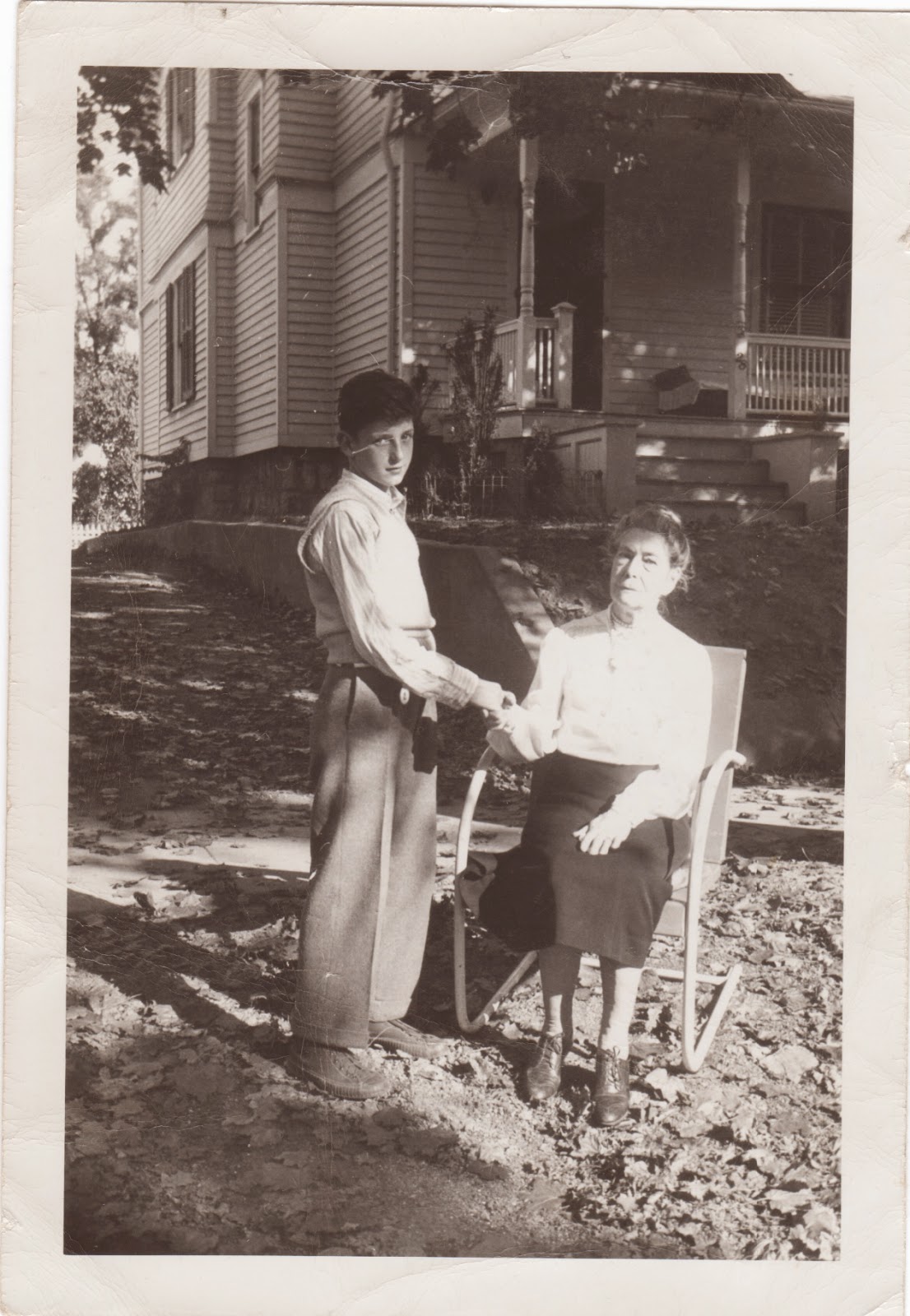
Most importantly, I heard some stories that shed a little bit of light on the personality of Grandma Julia.  My father's cousin Jack grew up in Geneva and lived with his grandmother, so he could tell us a few things about her.  
Jack with Grandma Julia, mid-1940s
Julia was a hard-working woman.  After her husband died in 1916, she kept a boarding house, and would get up every day at 4 am to start the day's baking.  She was no-nonsense with the children, but must have had a kind heart, because she was always ready to feed hungry strangers at the back door.  

Jack told about how her five adult sons would sit in the living room drinking their whiskey; when offered a shot, Julia would grimace and protest, refusing to take more than a sip.  When the men left the room and she thought no one was watching, she would drink it straight down, pretty as you please.  

Whenever anyone was sick, she would insist they take the "cure" -- whiskey, water, and a spoon of sugar.  It got so that sometimes the kids would go into the kitchen and cough hopefully at her.  

On St. Patrick's Day, she would bake a cake, and when it came out of the oven, she would spread out newspapers and throw the cake against the door.  It would break into pieces and everyone had to eat a piece of the broken cake for good luck.

Jack told about the divisions between the Irish and the Italian kids.  The Italians had to go through the Irish neighborhood to get to school.  Jack, a slight boy, used to sit outside as bait, taunting the Italian kids.  When they started to come at him, his bigger cousins would jump out from the bushes.  If the noise got too loud, their grandmother would come out of the house with a broom to shoo everyone back to their side of the tracks.

Now here's when you know that there is the hand of fate in family history: my new cousin Carol arrived a few days before the reunion and went to visit St. Patrick's cemetery, where our great-grandparents are buried -- only to find that she had no clue where to look for them in the enormous expanse of gravestones.  Ready to give up, she ran into a gentleman walking nearby, who asked her who she was looking for.  She told him.... and Jack led her straight to the family plot.  Of course the random person she happened to meet would be the only person in Geneva who could help her!  

image courtesy of  thegraphicsfairy.com


Friday, October 18, 2013

Trust but Verify...

I still have the notes I took the first time I interviewed a relative about our family history.  I was around twelve years old and saw myself as quite the detective, with my small spiral notepad in hand and a pencil behind my ear.  My grandfather told me that his parents were immigrants.  His father came from England and his mother from Ireland -- and that she had come to America alone, on a cattle boat.

Of course, I asked all the wrong questions and left out the most important ones, but those notes are precious to me because my grandfather died before I had the chance to sit down with him again and do it right.  So the notes I took as a twelve-year old were all I had to direct my research.  

But..... as we all know well:  you can't take any evidence at face value, even from the best of sources.  For years I assumed my great-grandmother Julia had no family in America, because her son told me that she came over by herself.  If I had just accepted Granddad's statement as literal fact, I would still be staring at that dreaded brick wall.  

The secret is to keep asking questions about your hypotheses, play devil's advocate...and please, don't assume the records are all 100% accurate! (I've got another blog post coming up about how an "official" city marriage record is dead wrong....)  So follow that old Russian proverb from the cold war and "trust, but verify!"  


For those who are interested in the family of Julia Flynn and John Joseph Hill of Geneva, New York, here are some details on my research process:

The first evidence I found for Julia Flynn was her 1896 marriage to John Joseph Hill in Geneva -- the marriage record gives us a link to an earlier generation by including the names of their parents (Julia was the daughter of Margaret Kelly and John Flynn; John Joseph was the son of Thomas Hill and Elizabeth Scott).  After that, Julia and John Joseph appear in the 1900 and 1910 federal census of Geneva (Julia is also found in all other census enumerations through 1940).  The only other records I have for them are John Joseph's 1916 death certificate and both of their burial records from St. Patrick's Cemetery in Geneva.   As recent immigrants, they didn't leave much of a trail.
John Joseph Hill, Julia Flynn Hill and son Robert, ante 1916
Not too long ago, FamilySearch digitized many of the NY State censuses, which provided the break I needed.  The 1892 state census was taken four years before Julia's marriage, so I searched for her under her maiden name, "Flynn" and, as expected, found her in Geneva:


One problem with the 1892 NY census was that it did not list people by household; it is just one running list of individuals.  You can only guess about the composition of the households by seeing who is enumerated next to whom.  In this case, Julia appeared at the top of the page, but if you look at the person directly before her in the list, you find this:


 Margaret Flynn..... hmmm.... I know from her marriage record that Julia's mother's name was Margaret.  I wonder if this could be her??????

So next I went back to the 1900 census of Geneva, and found a Margaret Flynn of about the same age listed as "mother-in-law" in the household of Agnes and William O'Brien.  And, applying genealogy rule #1, I went back and rechecked my earlier sources:
  • I found that an Agnes Flynn had witnessed Julia and John Joseph's 1896 marriage.
  • My grandfather had said that his mother had two sisters and a brother:  Aggie, Maggie, and Jim.  Somehow, over the years (since I was 12...) I had forgotten that detail!  It just reminds me how important it is to reexamine your sources every now and then.  Facts that you overlook one time may jump out at you when you look at them later.

Certainly Agnes must be "Aggie!"  I checked to see if there were any newspaper articles about her on  Old Fulton Postcards, and found a 1948 obituary, which included information that she left a sister, Mrs. Julia Hill, and five nephews.  Score!
Geneva (NY) Daily Times, 3 March 1948

Julia's sister Margaret's story is more poignant.  In the 1910 census, the O'Brien household included a widowed Margaret Fitton, identified as William O'Brien's sister-in-law.  This household also included his wife Agnes C., a 7-year old nephew John V. Fitton, and his mother-in-law, Margaret Flynn.  By the 1915 NY state census, both the O'Brien and Fitton families had moved to Rochester, and the younger Margaret had remarried.  Her second husband, John Culhane, was a widower, and they had a blended household  consisting of his two children, Margaret's son, and her mother.  So with that outline of their family structure, I then went back to the newspapers and discovered her story.

On 27 September 1898, the Geneva Advertiser reported that John Fitton had become totally blind, saying: "It came on him very suddenly early in the summer.  He was at work, and at first he says spots seemed to float before his eyes, then everything seemed to turn yellow, then dark, and he hastened home while he was able to get there."  Doctors gave him very little hope of regaining his vision, and the paper editorialized: "Brethren, this is tough.  He is a young man, with a wife but no children, and the future cannot be bright for him." According to the census records, their only son, John V. Fitton, was born ca. 1903, after his father became blind.

The Geneva Daily Times carried this story in its edition of 27 April 1905:

The article continues on, describing John's last moments in great detail. To me, the most interesting thing about it is that it ends by naming the parents, siblings, and child of the deceased, but notes only that he left "a widow," without naming her.  Am I being paranoid to think that this might be an example of anti-Irish sentiment?  The article also ties together several clues from other sources -- it confirms that John A. and Margaret Fitton lived on Burrall Street, the same street as Julia and John Joseph Hill.  It also confirms that John A.'s father lived on Main Street, as did a Dr. Hopkins, who treated him after he took the arsenic.  In the 1900 census, a Margaret Fitton was enumerated as a married servant in the household of a Dr. William Hopkins, residing on Main Street in Geneva!

The underlying theme of this entire research project is to find Julia's origins in Ireland.  Once I knew Julia's sisters and mother were in America, too, I did a few searches on www.FamilySearch.org, and found the following passenger record from the port of Philadelphia, dated 12 August 1888, which looks suspiciously like our family:

Unfortunately, no record was made of their home town, so the search continues.

Still, out of all the Flynn siblings, I really knew nothing about Julia's brother Jim.  The notes I took when I interviewed my grandfather all those years ago suggest that he died in St. Louis.  That was good luck, because the Missouri state archives has placed a wealth of data online, and I was easily able to find this:


This was a major breakthrough -- the first documented evidence I've found so far of this family's place of origin in Ireland.  (I'll leave the ensuing happy dance to your imagination!)

As you can see, this is ongoing research.  I still need to find the death certificate for the matriarch, Margaret Flynn, as well as birth and marriage records for Julia's sisters and their families.  This is high on my "to do" list for my next visit to the National Archives in Manhattan, which is the closest repository for the NY birth/marriage/death index.  Another open question is when and where were they all naturalized?  As early as 1892, the Flynn women appear as "citizens" on the census.  Sometimes this was just the census taker being lazy, but it was consistent enough to make me think that they had a male relative who was naturalized and through whom they automatically became citizens.  Was this James, or did their father, John, come over as well?  The latter doesn't seem likely because the mother didn't arrive in America until 1888.  Maybe now I know where to look, I can find records for the family in County Cork!

Click this link to see a spreadsheet summarizing all the documents I have found for this family.  I find it a really useful way to see all the data I have for one person at a glance. By examining the consistency of the data, together with the reliability of each data source, I can more readily assess the accuracy of my evidence.